


For a long time, sleeping less was a status symbol in Hong Kong. Six hours was fine. Four was practically a flex. Exhaustion was proof of ambition and grit. But as we look at the shifting landscape of fitness in Hong Kong, sleep wellness is finally taking its rightful place in the spotlight.
A growing number of health-conscious professionals and athletes are seeing sleep with newfound clarity — not a leftover after everything else but as a non-negotiable foundation. Poor sleep doesn’t just make you tired. It elevates cortisol, impairing both fat metabolism and muscle recovery. It disrupts the hormonal signalling that controls hunger, leading to poorer food choices the following day. For anyone engaged in regular training, insufficient sleep is the single most significant barrier to progress.
Hong Kong consistently ranks among Asia’s most sleep-deprived cities. The shift in wellness is visible in everyday behaviour, from the rise of wearables to the demand for nervous system reboots like breathwork and infrared saunas.
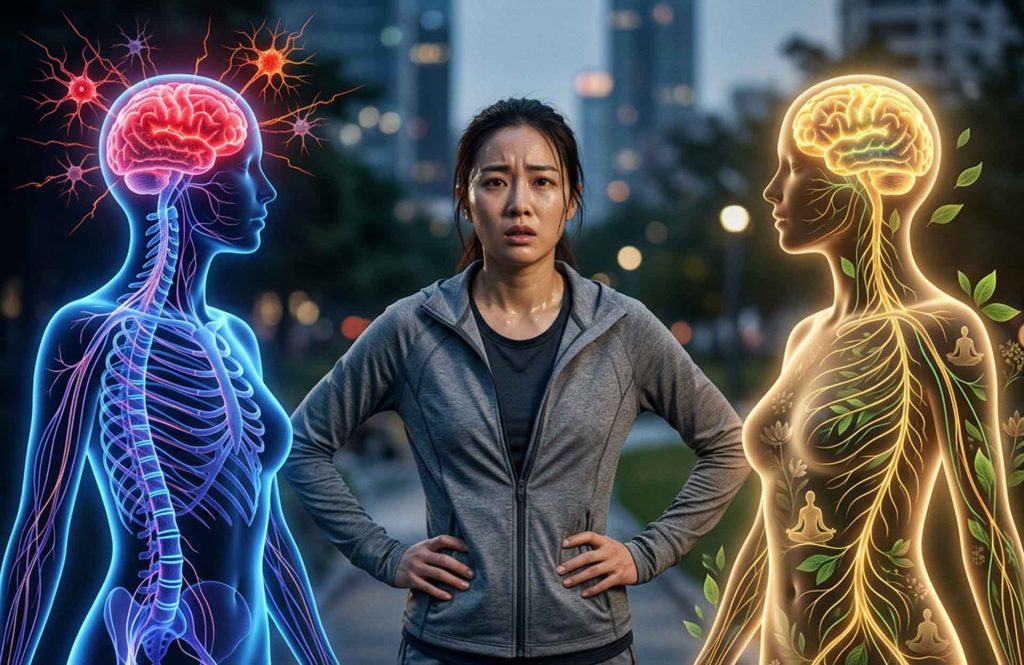
But sleep quality isn’t just about clocking hours; it requires precise biological cues. Temperature plays a vital role—the body’s core needs to drop by about 1°C to initiate deep sleep, making 18-19°C the optimal room temperature. Consistency anchors your circadian rhythm. Going to bed and waking up at the same time, even on weekends, is far more important than trying to “catch up” on lost hours. Your nervous system state dictates whether you actually recover — if you fall asleep stressed, your heart rate variability (HRV) remains low. This is why decompression matters enormously—dedicating 60 minutes before bed to disconnect from blue light, using reading or light stretching to shift from sympathetic (fight-or-flight) to parasympathetic (rest-and-digest) dominance.
Sleep isn’t passive—it is the ultimate active recovery.